
Cobb County Arrest Records and Court Charges
Arrest records in Cobb County are not the same thing as the finished criminal case file. The Sheriff's Office operates the Adult Detention Center at 1825 County Services Parkway in Marietta and says its inmate search can show people in custody, criminal charges, and bond amounts. That is the custody side of the record. The court side begins when a charge is presented through Magistrate Court activity, a State Court misdemeanor accusation, or a Superior Court felony indictment.
Cobb's own court research is especially important for misdemeanors: the State Court Clerk says arrest-case information is not available through that clerk until the Solicitor General files an accusation and the Clerk dockets the case. Until then, the useful records may be with the jail, Magistrate Court, the Solicitor General, or law enforcement. For booking and custody detail, use Cobb County inmate records. For the full case file, plea, disposition, and sentence, use Cobb County criminal court records.
The Cobb County Sheriff's Office homepage is one starting point for arrest-to-custody records.

Use the sheriff channel for jail and booking-related questions, then move to court portals once formal charges have been filed.
How to Find Cobb County Arrest Records and Charges
Start with the record holder that matches the event. If the person is currently in custody, use the sheriff inmate search or call the detention inquiry line at (770) 499-4200 if the portal is down. If the case involves a warrant, first appearance, small criminal matter, or bad-check citation, use Magistrate Court records and the Magistrate Warrant Division. If the prosecutor has filed a misdemeanor accusation, use State Court records. If the case is a felony, use Superior Court and District Attorney channels once the indictment or filed case exists.
- Check the Cobb Sheriff inmate search for current custody, charges, and bond amounts when the person may still be detained.
- Search Magistrate Court records for warrant, preliminary, minor criminal, citation, or related records.
- Use State Court Records Search for misdemeanor cases after accusation and docketing.
- Use the Clerk of Superior Court records-search hub for felony case access after filing or indictment.
The Sheriff's custodial information page identifies the inmate search as a source for criminal charges and bond amounts.
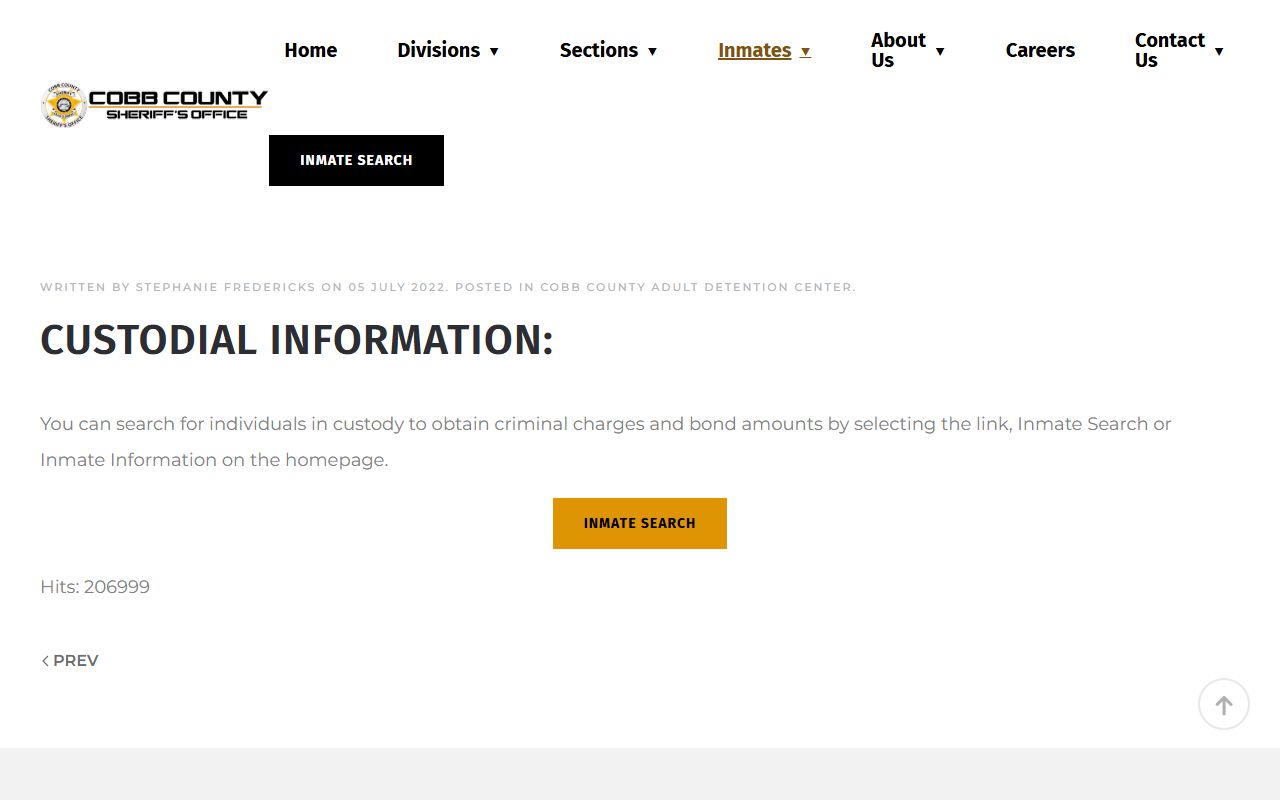
That jail result can be an early snapshot, while the later court record may show amended charges, dismissals, pleas, or sentencing.
How Charges Get Filed After an Arrest: Accusation and Indictment
Georgia terminology matters. A misdemeanor charge in Cobb commonly becomes a State Court case when the Solicitor General files an accusation. A felony charge moves through Superior Court, often after indictment or other Superior Court filing. Magistrate Court may appear earlier because it handles warrants, preliminary criminal matters, and some minor criminal processes. A single arrest can therefore produce jail booking charges first, then a separate court charge record later.
| Magistrate / Warrant Stage | State Court Accusation | Superior Court Indictment | |
|---|---|---|---|
| Filed By | Officer, applicant, or court process | Solicitor General | District Attorney / grand jury process |
| Common For | Arrest warrants, first steps, minor criminal matters | Misdemeanors and traffic-criminal matters | Felonies and felony juvenile prosecutions |
| Record Channel | Magistrate records or Warrant Division | State Court Clerk | Superior Court Clerk |
The Magistrate Warrant Division page explains the warrant side of this pathway.
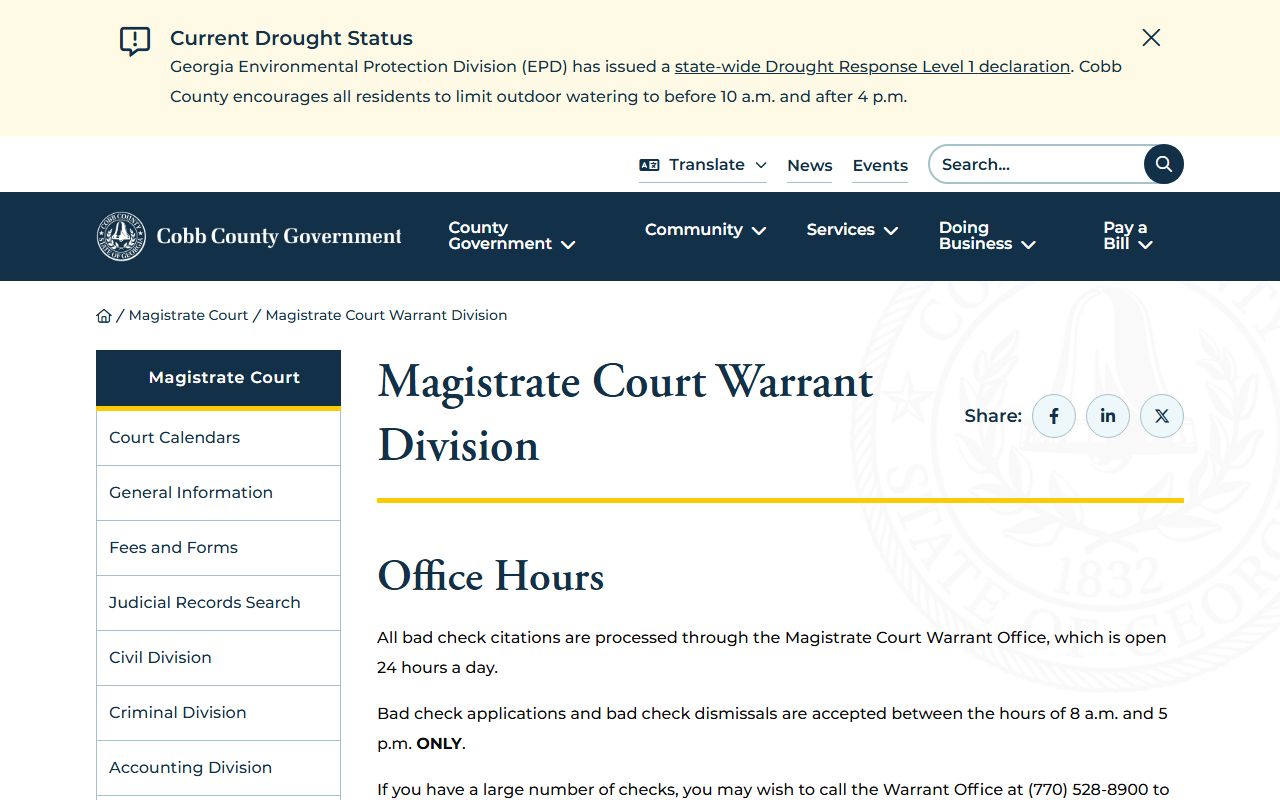
Magistrate warrant information can explain why an arrest occurred before a State Court or Superior Court case has a final case posture.
Charge Status and What It Means
Charge status can change as prosecutors review evidence, witnesses appear, negotiations occur, or a judge rules on motions. A charge listed at booking is not always the charge that appears in the final accusation or indictment, and a filed charge is not a conviction. Cobb court records may include docket entries, bond orders, plea entries, dispositions, sentence information, and restrictions or redactions when law requires.
| Status | What It Means |
|---|---|
| Pending | The charge has not reached final disposition, or the case remains active in the court that holds it. |
| Amended / Reduced | The prosecutor or court record reflects a changed charge, charge level, or charging language. |
| Dismissed | The charge was ended by court action and should be read separately from any other remaining counts. |
| Nolle Prosequi | The prosecutor declined to continue that charge, subject to the exact order and case context. |
Charges vs. Convictions
A charge means the government has accused a person of an offense. A conviction means the charge ended in a guilty plea, verdict, or similar final outcome. Cobb records may show both, but the distinction is essential when reading an arrest-related result, a docket entry, or a background-check summary. Bond amounts and jail charges describe custody status, not guilt.
| Charge | Conviction | |
|---|---|---|
| Stage | Accusation, indictment, warrant, or booking allegation | Final plea, verdict, or adjudicated outcome |
| Proof Point | Probable cause or prosecutor filing | Court finding or accepted plea |
| Record Reading | Check current status and later amendments | Check sentence, probation, and disposition terms |
Sealed vs. Expunged Records
Georgia commonly uses the term record restriction rather than expungement. O.C.G.A. 35-3-37 governs criminal-history review, correction, and restriction for eligible matters. For arrests after July 1, 2013, the GBI guidance in the research says the person usually contacts the prosecutor rather than applying through GBI. Cobb also has the Second Chance Desk at the Circuit Defender's Office, a partnership that helps people review Cobb criminal history and restriction forms.
| Sealed / Restricted | Expunged | |
|---|---|---|
| Visibility | Limited from ordinary public access by law or court order | Georgia records are more often described as restricted, not erased |
| Law Enforcement | Criminal-justice access may remain in some situations | Do not assume every agency record disappears |
| Eligibility | Depends on O.C.G.A. 35-3-37, prosecutor review, and case result | Use Georgia-specific restriction rules rather than generic expungement language |
Charge Codes and Severity Levels
Cobb charge records may identify the court, case category, defendant, filing date, charge language, docket activity, bond, disposition, and sentence. Superior Court handles felony matters. State Court handles misdemeanors, traffic violations, and civil matters not reserved to Superior Court. Municipal courts in Marietta, Smyrna, Powder Springs, Acworth, Kennesaw, and Austell handle city traffic and ordinance cases, with jury-trial demands moving to State Court.
Severity is usually tied to the court path. Felony charges belong in the Superior Court system after filing, and the District Attorney prosecutes felony and felony juvenile violations of state law in Cobb County. Misdemeanor charges generally move through State Court after the Solicitor General files an accusation. Traffic-criminal charges can stay in State Court or a municipal court depending on where the citation was issued. A charge label should be read with the court name, filing date, and disposition because an early booking label may not match the final filed count.
Statewide Charge and Criminal History Lookups
State-level resources are supplemental, not replacements for Cobb case files. The Georgia Department of Corrections Offender Query is for state prison and probation records, not current Cobb jail custody. The Georgia Courts e-access page points users to a provider website and says an account is required to search court records. The GBI Sex Offender Registry is a separate statewide registry for registered offender information.
The manifest source for the statewide registry is the GBI public sex offender search.
Registry results should not be treated as the same thing as Cobb arrest records, current charges, or a complete criminal case file.
Background Check Considerations
For employment, housing, credit, insurance, or tenant screening, informal court searches are not a substitute for legally compliant background-check procedures. Cobb records may be incomplete online, updated after case-management changes, or limited by sealed, juvenile, adoption, medical, financial, or restricted-criminal-history rules. Verify with the originating office before relying on a charge result.
The Cobb Second Chance Desk is a local resource for people trying to understand record restriction and sealing eligibility. It operates through a partnership involving Georgia Justice Project, the Circuit Defender, the District Attorney, the Solicitor General, and the Cobb Judicial Circuit. The research places it at the Circuit Defender's Office at 10 East Park Square, with Friday hours from 9 a.m. to noon, appointment priority, and contact at 404-834-8604 or secondchancecobb@gjp.org. That service does not make a charge disappear from every record system, but it is the researched Cobb-specific route for restriction help.
Important: No consumer report is provided here, and these records cannot be used for FCRA-regulated screening decisions.
Restricted Charge Records in Cobb County
Restricted arrest and charge records include juvenile court records, sealed or restricted criminal-history information, adoption files, mental-health matters, Social Security numbers, financial account information, minor identities, and law-enforcement material tied to active investigations. Sheriff's open records go through the GOVQA portal or sheriff PDF form for booking photos, incident reports, or jail records not shown online. The State Court landing page is the local route for State Court case access after filing.
The State Court manifest image comes from the Cobb State Court page.
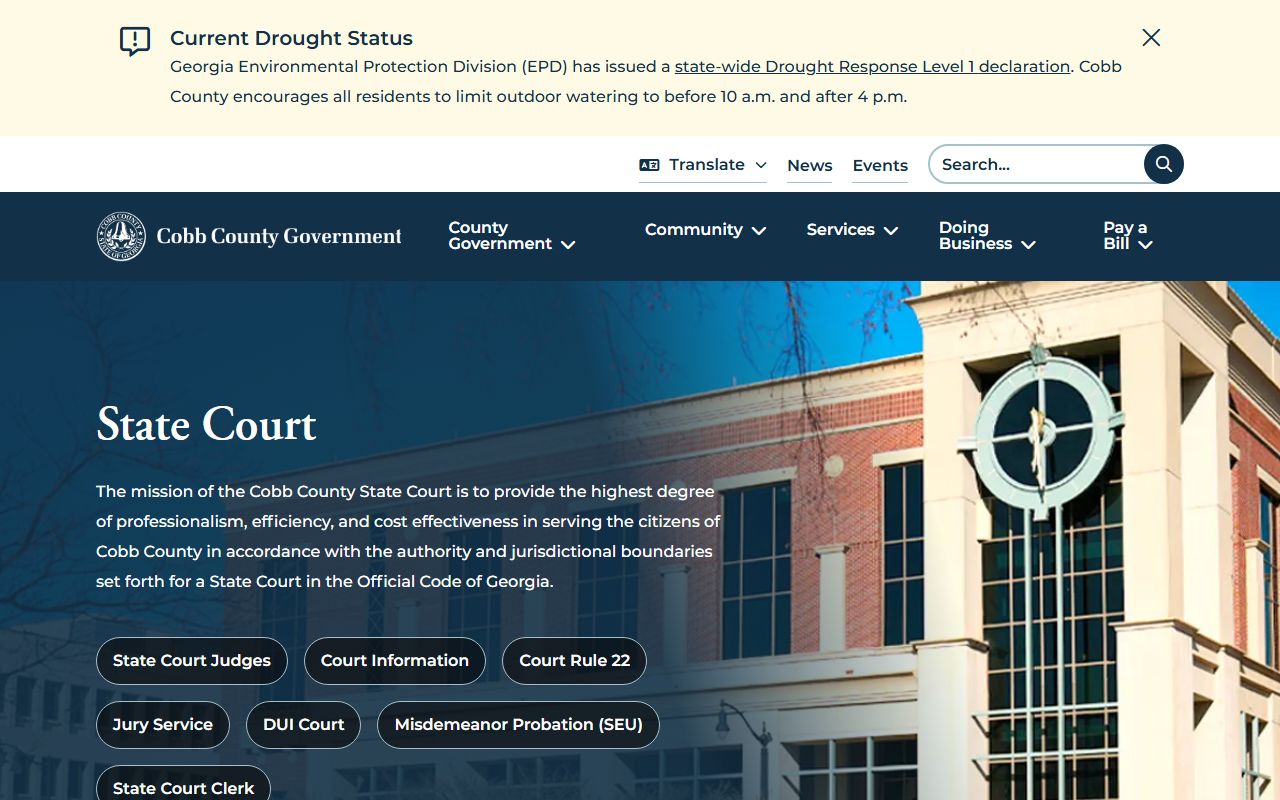
Use State Court for docketed misdemeanor charges, and use the prosecutor, sheriff, or Magistrate channel when the matter has not reached that docket. Confirm the court before relying on a charge result for a deadline, bond issue, or court appearance.