
Search Cobb County Court Records
Cobb County court records are not stored in one search box. The Cobb Courts landing page points users to Superior Court, State Court, Probate Court, Juvenile Court, Magistrate Court, the District Attorney, the Solicitor General, the Circuit Defender, and the Law Library. The right search path depends on the case. Superior Court is the route for felony, divorce, land-title, equity, and broad civil matters. State Court is the main route for county traffic, misdemeanors, and many civil cases. Magistrate Court covers small claims, dispossessory cases, warrants, minor criminal matters, and preliminary steps.
Online search is only the first channel. State Court and Magistrate Court have public record searches with reCAPTCHA. The Clerk of Superior Court has a records-search hub and a separate real-estate public inquiry. Probate Court links to case status and docket search. If a portal is down, incomplete, or not official enough for court use, the fallback is the clerk or office that maintains the file.
- Choose the court first: Superior, State, Magistrate, Probate, Juvenile, municipal, or sheriff records.
- Open the matching Cobb portal, such as State Court Records Search, Magistrate Court Records Search, Superior Court Clerk records search, or Probate Case Status and Records Search.
- Search by name, case number, citation number, tag number, date range, or court-specific field when available.
- Use docket entries, court dates, filing dates, and party names to confirm that the match is the correct Cobb County record.
- Request a clerk copy or certified copy when the online result is not enough for filing, licensing, school, employment, or legal proof.
The Cobb County government homepage is shown in this local screenshot from the image manifest.
That countywide entry point is useful for departments, alerts, and official office links, but court record searches still depend on the court that owns the case.
Cobb County Court System
Georgia uses multiple trial court classes rather than a single county trial court. In Cobb County, Superior Court is the broad trial court for felonies, divorce, equity, title-to-land cases, and general civil or criminal matters. State Court handles traffic violations, misdemeanors, and civil lawsuits not reserved to Superior Court. Magistrate Court handles small claims, evictions, warrants, bad checks, minor criminal matters, and preliminary stages.
Probate Court covers estates, guardianships, conservatorships, marriage licenses, weapons carry licenses, and mental-health matters. Juvenile Court handles cases involving children. Municipal courts in Marietta, Smyrna, Powder Springs, Acworth, Kennesaw, and Austell handle city traffic and ordinance cases. Jury-trial demands from city cases can move to Cobb State Court.
Case flow: Magistrate or municipal first step › State Court or Superior Court filing › Georgia Court of Appeals › Supreme Court of Georgia when jurisdiction allows.
| Court | Main Cobb role | Common records |
|---|---|---|
| Superior Court | Broad civil and criminal jurisdiction | Felony files, divorce decrees, land-title actions, equity cases |
| State Court | County traffic, misdemeanors, and civil matters | Citations, misdemeanor accusations, civil suits, docket entries |
| Magistrate Court | Small claims, evictions, warrants, preliminary matters | Warrant records, small claims, dispossessory filings, bad-check matters |
| Probate Court | Estates, guardianships, licenses, mental health | Estate files, marriage copies, guardianship records, probate docket data |
The Georgia court hierarchy resource provides the statewide context behind Cobb County court routing.
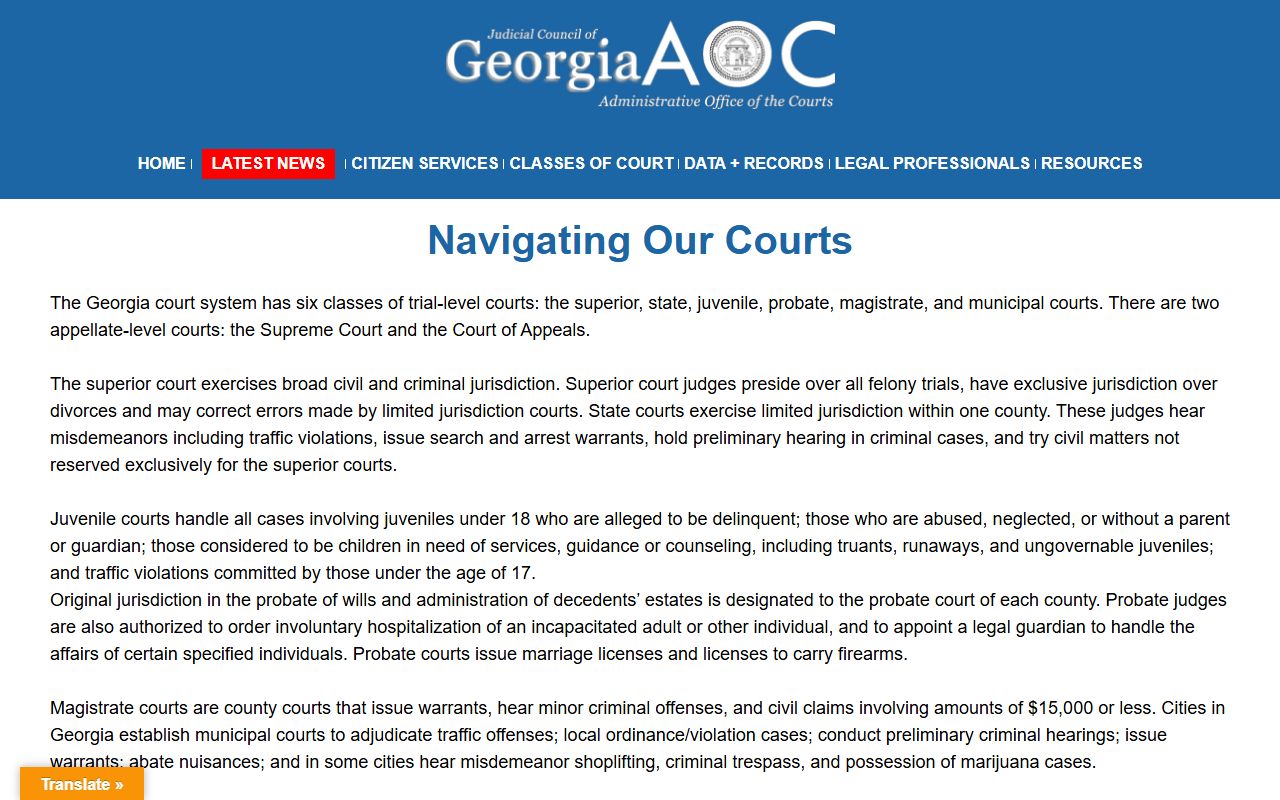
This matters because a record request sent to the wrong Cobb County court may come back empty even when a valid case exists elsewhere.
Cobb County Court Campus
Cobb County's court campus is concentrated around Marietta Square. Superior Court and the Clerk of Superior Court are listed at 70 Haynes Street. State Court and the Clerk of State Court are at 12 East Park Square. Probate Court, Magistrate Court, and Juvenile Court functions use 32 Waddell Street. The Superior Court real-estate division is listed at 10 East Park Square, Building C. The Sheriff's Office and Adult Detention Center sit away from the square at 1825 County Services Parkway.
Probate and Magistrate
32 Waddell Street
Marietta, GA 30090
(770) 528-1900 / (770) 528-8900
The official Cobb Courts page identifies the county court offices in one place.
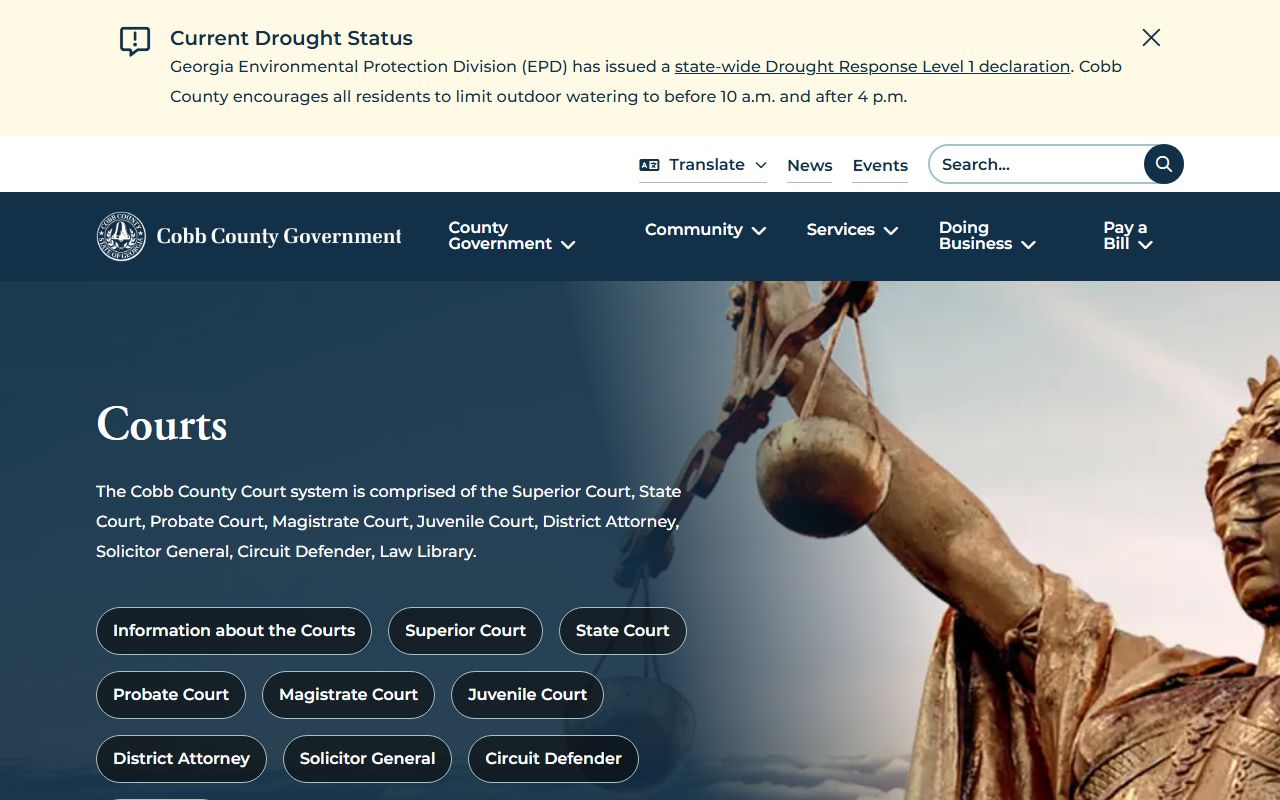
The court campus layout helps explain why in-person record requests may require different counters even when all offices are near Marietta Square.
Cobb County Court Record Types
Cobb County court records include civil suits, criminal cases, traffic citations, family and divorce filings, probate matters, marriage records, warrants, juvenile matters, and real-estate or lien instruments. A civil case may be in Superior Court or State Court. A felony case becomes a Superior Court record after indictment or filing. A misdemeanor generally becomes a State Court record after accusation. Before that point, arrest, warrant, or first-appearance details may sit with Magistrate Court, the Sheriff's Office, or the prosecutor.
Family and divorce records are Superior Court records, while marriage licenses and certified marriage copies come from Probate Court. Probate files cover estates, guardianships, conservatorships, and mental-health matters. Cobb traffic records are split between State Court for unincorporated county citations and municipal courts for city cases.
- Criminal court records: felony files in Superior Court and misdemeanor files in State Court after formal filing.
- Civil court records: complaints, answers, motions, orders, judgments, garnishments, and cost entries.
- Family and divorce records: Superior Court case files and decrees, with copy requests through the Clerk of Superior Court.
- Probate records: estate, guardianship, conservatorship, marriage-license, and mental-health docket materials when public.
- Traffic records: citations, case numbers, court dates, payment status, dispositions, and failure-to-appear data.
What Cobb County Records Show
Cobb County court records show different fields by court and case type, but common identifiers repeat. State Court and Magistrate Court searches use names, case numbers, filing dates, and sometimes citation or tag number. State Court examples include case number format guidance, date-of-birth year for criminal or traffic name matching, and filing-date ranges. Magistrate search results can include case, document, and judgment information, though the official court record controls if the online view differs.
| Field | What it shows in Cobb County |
|---|---|
| Case number | Local case identifier, such as State Court format examples or Superior Court civil numbering. |
| Filing date | When the case, citation, warrant matter, or document entered the court system. |
| Parties | Plaintiff, defendant, petitioner, respondent, company name, or other indexed parties. |
| Charges or cause | Criminal accusation, indictment, citation offense, civil claim, probate petition, or warrant matter. |
| Docket entries | Hearings, filings, orders, court dates, payment events, and other activity in the case. |
| Disposition | Final outcome, paid citation disposition, plea, judgment, dismissal, sentence, or order. |
Cobb County Public Access Rules
Georgia open-records law starts from broad public access, but Cobb County court records still depend on the custodian and the type of file. The Clerk of Superior Court handles Superior Court files, divorce decrees, and real-estate records. The State Court Clerk identifies Tahnicia Phillips as records custodian for State Court records under O.C.G.A. 50-18-71 and accepts requests at StateCourtRecords@cobbcounty.gov or the East Park Square address. Sheriff's booking, jail, and law-enforcement records use the sheriff open-records channel.
Key statutes and rules:
O.C.G.A. 50-18-70 states Georgia's policy favoring prompt public access to records.
O.C.G.A. 50-18-71 covers inspection, copying, timing, and lawful costs.
O.C.G.A. 50-18-72 lists exemptions for records that need not be disclosed.
Uniform Superior Court Rule 21 treats court records as public unless law or a limited-access order restricts them.
The Georgia eAccess court records page is a statewide fallback that points to an account-based provider path.
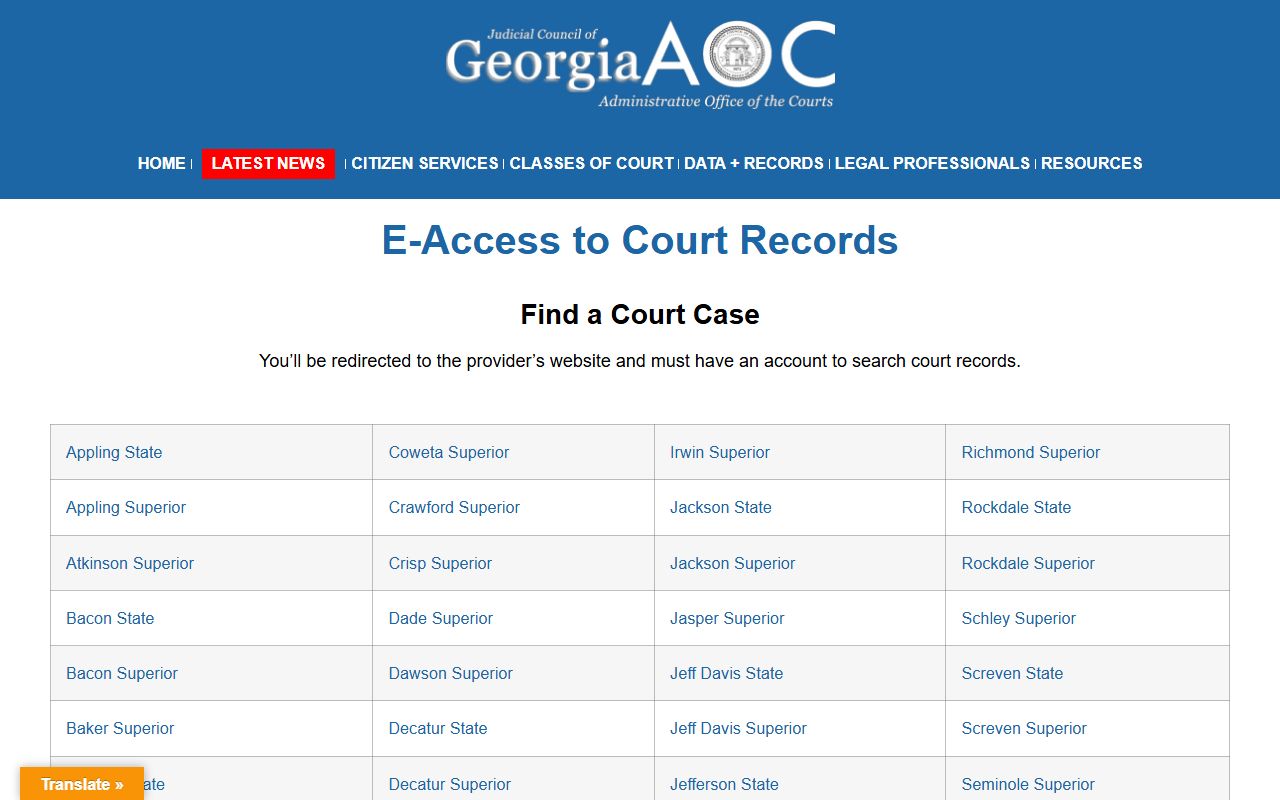
Statewide access may help with broader searches, but Cobb's direct court portals and clerk counters remain the best source for local official records.
Restricted Cobb County Court Records
Not every Cobb County court record is public in full. Juvenile records are governed by Georgia juvenile statutes and are not treated like adult criminal files. Adoption records are sealed under O.C.G.A. 19-8-23. Probate mental-health records may contain medical or capacity information. Criminal-history record restriction under O.C.G.A. 35-3-37 can limit access for non-criminal-justice purposes, and a court sealing order can remove a case or document from public view.
Common redactions include Social Security numbers, financial account numbers, minor names, medical details, and other sensitive personal information. For Cobb criminal-history restriction help, the Second Chance Desk at the Circuit Defender's Office is a local resource. It is tied to Georgia Justice Project, the Circuit Defender, the District Attorney, the Solicitor General, and the Cobb Judicial Circuit.
Note: Online absence does not prove a Cobb County court record never existed; it may be sealed, restricted, not yet filed, or held by another office.
Cobb County Specialty Courts
Cobb Superior Court lists Drug Treatment Court, Mental Health Court, Veterans Treatment Court, and Parental Accountability Court at 10 East Park Square, Suite 200. These programs are part of the court system, but access to participant records may be more limited than ordinary docket entries because treatment, health, dependency, or family details can be involved.
The Veterans Accountability and Treatment Court diverts eligible veteran defendants with substance dependency or mental illness into a specialized criminal court model. Cobb also opened a recovery-program facility in 2026 with group rooms, counseling offices, a common gathering area, and on-site drug and alcohol testing for Veterans, Mental Health, DUI, Drug Treatment, and Family Treatment Courts.
Cobb County Sheriff and Jail
The Cobb County Sheriff's Office is at 1825 County Services Parkway in Marietta. Sheriff Craig Owens took office January 1, 2021. The office runs jail operations, court security, criminal warrant execution, civil process, mental-health transports, forgery and fraud investigations, fugitive apprehension, and detention records. The Adult Detention Center is a pretrial facility with about one million square feet under roof.
The official sheriff inmate search returns custody information, criminal charges, and bond amounts when available. If the online Detainee Search is under maintenance, the sheriff has directed the public to call (770) 499-4200 for detainee information. The sheriff's office also promotes the Cobb County Sheriff's Office GA app for push notifications and real-time alerts, but app-only inmate or warrant lookup was not confirmed in the research.
Cobb County Marriage Probate Records
Cobb Probate Court issues marriage licenses and certified marriage copies. Divorce decrees are not Probate Court records; they are Superior Court records held by the Clerk of Superior Court. Probate Court also handles estates, guardianships, conservatorships, weapons carry licenses, and mental-health matters. Marriage licensing and divorce copies therefore use different counters, even though both are common family-record requests.
- Testator
- A person who made a will.
- Executor
- A person named to manage an estate under a will.
- Conservator
- A person with court authority over another person's finances or property.
- Guardianship
- Court authority over personal care for a minor or incapacitated adult.
Cobb County Court Records Fees
Cobb County fees vary by office and record type. Certified copies cost more than plain copies because the clerk adds a seal or certification. Probate Court has detailed estate and guardianship filing deposits. Magistrate Court lists copy costs and certified-copy stamp fees. Traffic payments and warrant applications have their own fee rules.
| Item | Amount |
|---|---|
| Superior Court final divorce decree, regular copy | $3.00 |
| Superior Court final divorce decree, certified copy | $10.00 |
| Divorce decree with settlement agreement, regular copy | $9.00 |
| Magistrate Court certified copy stamp and seal | $2.50 |
| Magistrate Court copies per page | $0.10 |
| Probate Court certified copies | $10.00 first page plus $1.00 each additional page |
| Marriage license without premarital counseling | $56.00 |
Read Cobb County Court Records
A Cobb County court record often uses terms that are plain once the case path is known. A plaintiff starts a civil suit. A defendant is the party sued or accused. An accusation is a formal misdemeanor charging document used in State Court. An indictment is a grand-jury felony charging document used in Superior Court. A disposition is the final result of a charge or case, while a sentence is punishment ordered after a plea or conviction.
Charges are not the same as convictions. A jail booking charge, Magistrate warrant allegation, State Court accusation, and Superior Court indictment may describe different stages of the same event. A dismissed, reduced, amended, or restricted charge should not be read as a conviction unless the court record shows that outcome.
Cobb County Record Limits
Online Cobb County records can lag behind case-management updates. State Court says today's case-management updates are available the next day. The State Court search also warns against direct-query URL construction or data mining. Magistrate Court warns that the official court record controls over online discrepancies and that party addresses may reflect either filing-time or current case-management addresses.
Note: Confirm court dates, warrants, bond, certified copies, and deadlines with the office that maintains the record.
Cobb County Court History
Cobb County's official history says Marietta was settled in 1833, became the county seat in 1834, and received its official charter in 1852. The court campus still centers on Marietta Square, but Cobb now serves a large metro-Atlanta population with Superior, State, Probate, Magistrate, Juvenile, and municipal courts. Recent changes show the system adapting to volume and technology, including the State and Magistrate Court Clerk's Office Express drive-through service opened in 2026.
The Cobb County history page provides county-seat context for the court campus.
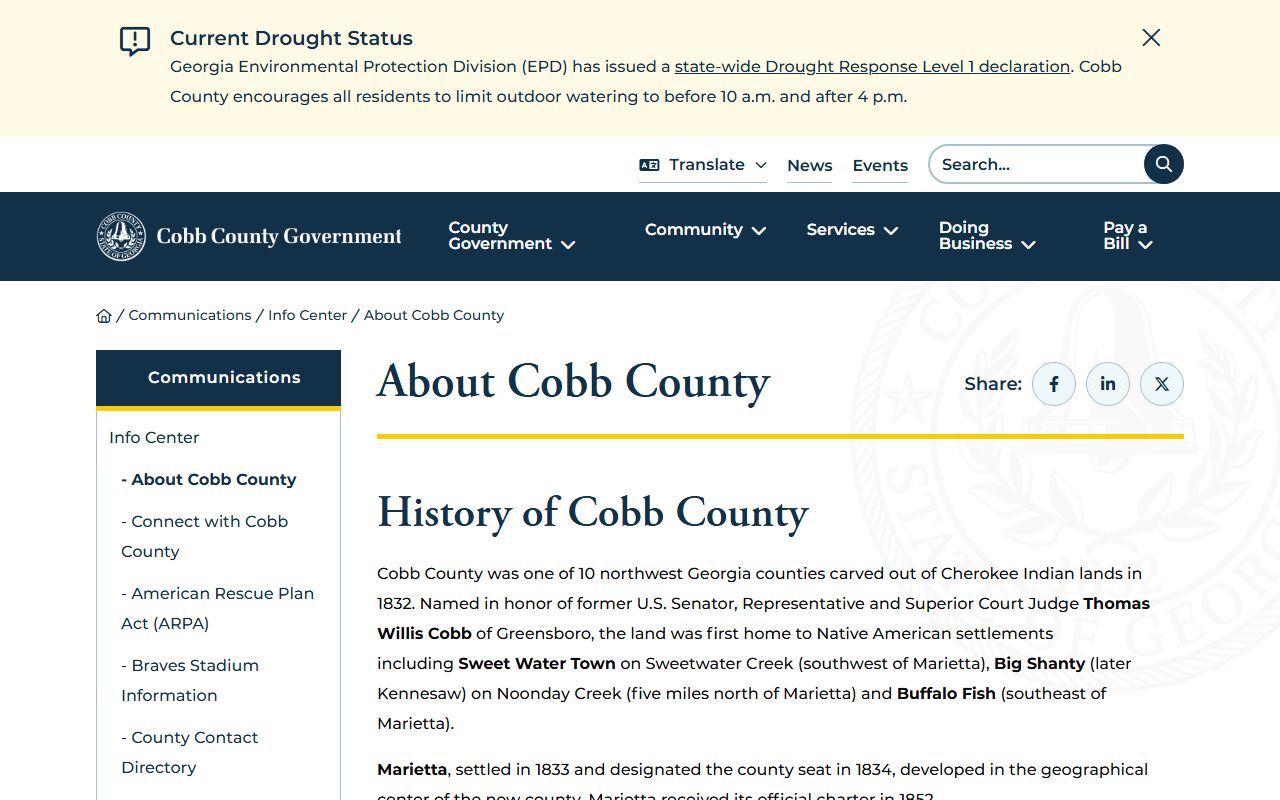
That local history is more than background; it explains why many court offices remain clustered in central Marietta.
Cobb County Court Records FAQ
Where do Cobb County court records start?
Start with the court that owns the case. Superior Court handles felonies, divorce, land-title matters, and broad civil cases. State Court handles traffic, misdemeanors, and many civil cases. Magistrate Court handles warrants, small claims, evictions, and preliminary criminal matters. Probate Court handles estates, guardianships, marriage, and related probate records.
Are Cobb County online court records official?
Online records are useful for lookup, but official records come from the relevant clerk or office. Magistrate Court warns that the official court record controls if there is an online discrepancy. Certified copies should be requested from the clerk that maintains the file.
Where are Cobb County inmate records?
The Cobb County Sheriff's Office provides the local inmate search for people in county custody. The search can show criminal charges and bond amounts. If the search is unavailable, detention inquiries go to (770) 499-4200.
Which office has Cobb County divorce records?
Divorce records are Superior Court records. The Clerk of Superior Court maintains divorce decrees and handles copy requests. Probate Court handles marriage licenses and certified marriage copies, not divorce decrees.
Public Record Search
Sponsored Results