
Cobb County Probate Records
Cobb Probate Court says it ensures estates and guardianships are administered according to law. The court lists sections for wills and estates, guardianships and conservatorships, mental health, marriage license, weapons carry license, case status and records search, fees, additional forms, process servers, resources, and a newsletter. That scope makes Probate Court the local office for estate filings, many fiduciary appointments, and certified probate copies.
The Probate Court fee page is one of the manifest sources for Cobb County probate records.
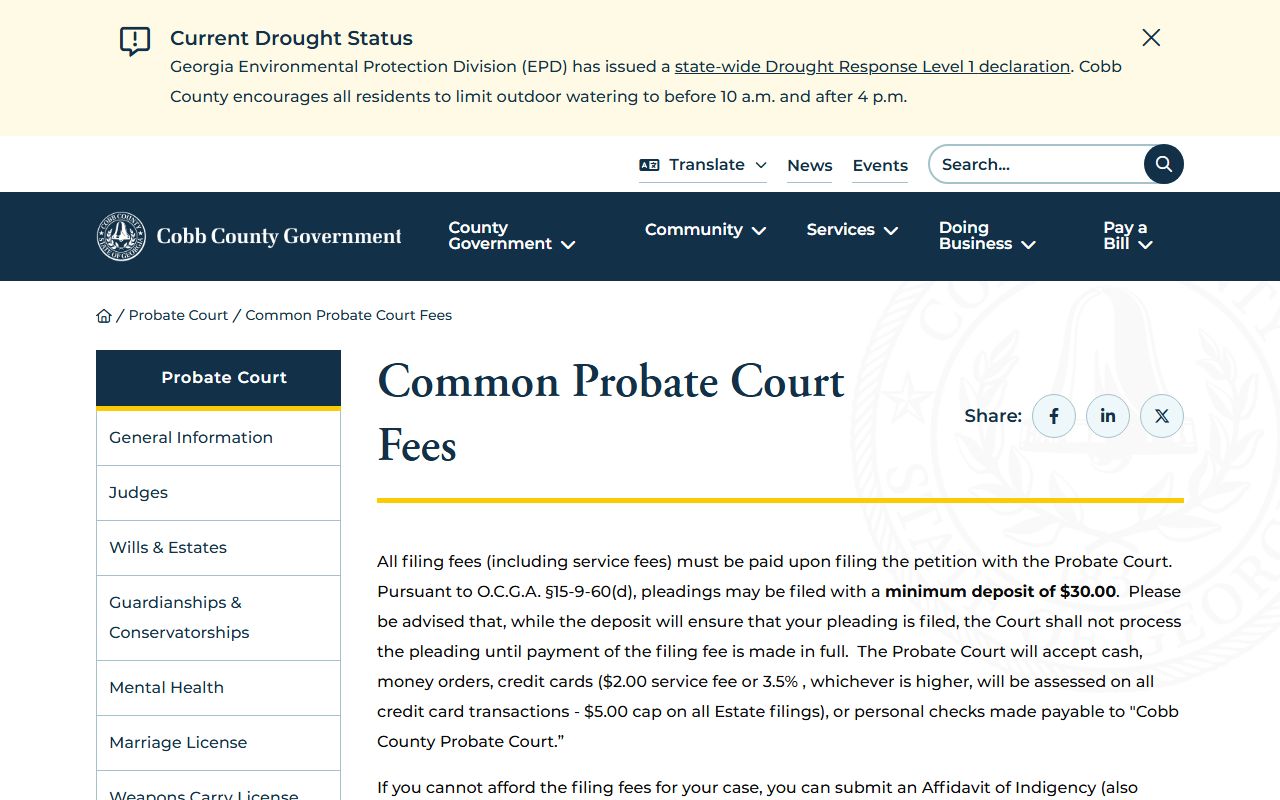
Probate Court fee and form pages should be checked before filing because deposits, service costs, and publication costs vary by petition type.
Cobb Probate Court
32 Waddell Street
Marietta, GA 30090
(770) 528-1900
probatecourt@cobbcounty.gov
Monday-Friday, 8 a.m.-5 p.m.
Cobb County Probate Terms
Probate files use terms that are common in estate and guardianship practice but not always plain to a searcher. These definitions match the research glossary and help explain what may appear in a Cobb County probate record.
- Testator
- A person who made a will.
- Executor
- A person named to carry out a will and administer estate duties.
- Intestate
- A death without a valid will controlling the estate.
- Guardianship
- Authority over the personal care of a minor or incapacitated adult.
- Conservatorship
- Authority over another person's finances or property.
- Caveat
- An objection, often filed in a probate matter.
Search Cobb County Probate Court
Probate Court links a case-status and records-search channel and says users can view the court docket through the online portal by date and/or judge. That is useful for case status and calendar review, but it does not mean every probate document is public online. Certified copies, older files, restricted matters, and document-level access may require direct Probate Court contact.
- Identify the case type, such as estate, administration, guardianship, conservatorship, safe-deposit box, caveat, mental health, marriage, or weapons carry matter.
- Use Probate Court's case-status and records-search link for docket or status information when public.
- Check the relevant forms before filing, including Georgia standard probate forms and Cobb estate forms.
- Submit the petition, filing deposit, and service or publication costs required for the case type.
- Contact Probate Court for certified copies or records that are not available in the online search.
Note: Probate Court does not handle probation; the research says probation inquiries are routed to State Court Misdemeanor Probation/SEU.
Cobb County Probate Forms
Probate filings often begin with a form, not a general letter. Cobb's additional-forms page points users to Georgia standard probate forms and Cobb estate division forms. The correct form depends on whether the matter involves a will, administration, year's support, temporary letters, guardianship, conservatorship, safe-deposit box access, or a caveat.
The Cobb Probate Court additional forms page is the second manifest image source for this record type.
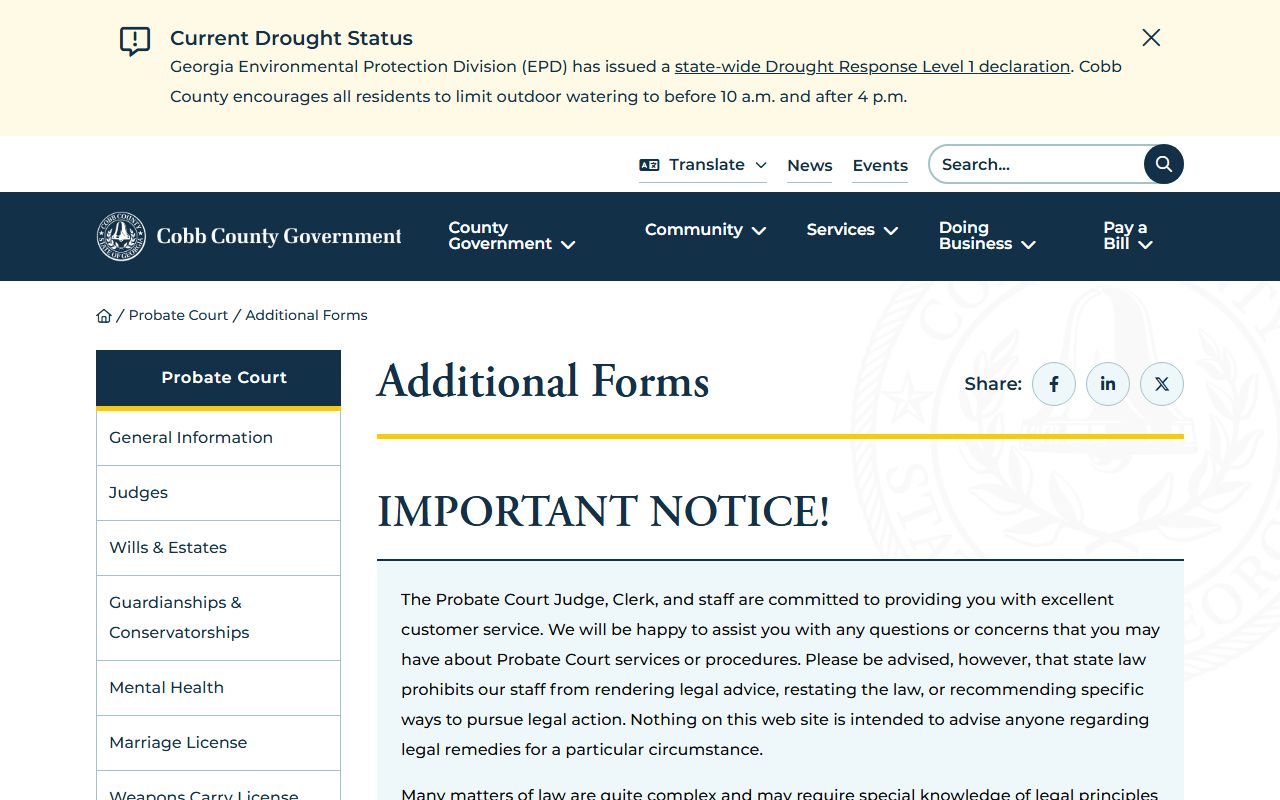
Use the forms page before filing because Probate Court will not treat an indigency filing as complete until the poverty affidavit is granted or fees are paid.
Cobb County Probate Filing Fees
Probate fees are due when filing unless an indigency request is granted. Probate Court accepts cash, money orders, credit cards, or personal checks payable to Cobb County Probate Court. The research also notes a credit-card service fee and possible extra service, publication, guardian ad litem, court-appointed attorney, or evaluator costs.
| Filing or Item | Fee |
|---|---|
| Minimum filing deposit | $30.00 |
| Letters of Administration without powers | $200.00 |
| Letters of Administration with powers | $320.00, includes $120 four-week publication |
| Petition to Probate Will in Solemn Form | $200.00 |
| Petition for Year's Support | $320.00 plus notice or certified-mail costs noted |
| Temporary Letters of Administration | $180.00 |
| Adult guardian or conservator petition | $645.00, includes attorney, evaluator, and service components |
| Objection or Caveat | $75.00 |
| Certified copies | $10 first page plus $1 each additional page |
A fee table should be read with the case type in mind. Letters of administration with powers include a publication component, while year's support may need notice or certified-mail costs. Adult guardianship and conservatorship petitions include several professional or service components. If the filing relies on an Affidavit of Indigency or Poverty Affidavit, the research says the document is not considered filed until the affidavit is granted or fees are paid.
File Cobb County Probate Cases
The probate walkthrough in the research starts with case identification. A person filing in Cobb County must know whether the matter is a will probate, administration, year's support, guardianship, conservatorship, safe-deposit box petition, caveat, mental-health matter, marriage matter, or weapons carry matter. That choice controls the form, filing deposit, service steps, publication costs, and later record access.
After the right form is selected, the filer submits the matter at Probate Court with the full fee or a proper indigency affidavit. Some matters require publication, certified mail, service, an evaluator, a guardian ad litem, or a court-appointed attorney. Estate and guardianship cases may also create future duties, such as an inventory or annual return, which then become part of the probate record when filed.
| Filing Step | Record Created |
|---|---|
| Petition filed | Case opening record, parties, requested authority, and fee entry |
| Service or publication completed | Proof that required notice was given |
| Letters issued | Official authority for the representative, guardian, or conservator |
| Inventory or return filed | Financial or estate-management filing, with access depending on case type |
| Discharge requested | Final accounting and closing request when required |
Cobb County Probate Record Contents
A probate record can contain petitions, wills, letters of administration, letters testamentary, notices, publication proof, inventories, annual returns, orders, objections, caveats, and certified copies. Guardianship and conservatorship matters can also include medical, capacity, care, or financial details. Mental-health cases are especially sensitive, so public access can be much narrower than it is for a routine estate file.
The value of a probate record depends on the stage of the case. A new estate file may show only the petition, parties, heirs, and requested authority. A later file may show letters, inventories, annual returns, discharge petitions, objections, or orders. A guardianship or conservatorship file may show who has authority to act, but public access may not include every medical or financial detail behind that authority.
| Probate Matter | Typical Record Content |
|---|---|
| Estate administration | Petition, appointment letters, service, publication, inventory, annual return, discharge records |
| Will probate | Will, solemn-form petition, heirs, notices, court orders, letters |
| Year's support | Petition, notice, publication or certified-mail costs, orders |
| Guardianship | Petition, appointment, care authority, restricted minor or capacity details |
| Conservatorship | Petition, financial authority, inventory, returns, restricted financial details |
Searchers should also distinguish Probate Court records from nearby court records. A will or estate case belongs with Probate Court. A divorce decree belongs with the Superior Court Clerk. A small claim or dispossessory belongs with Magistrate Court. A person looking for "probate" because of probation should use the State Court misdemeanor probation path instead, because Probate Court's research explicitly redirects probation inquiries elsewhere.
Marriage and weapons carry license matters also appear in Probate Court's service list, but those are not estate files. When requesting a record, naming the exact matter type helps the clerk separate a marriage-license copy, an estate docket, a guardianship order, or a mental-health case that may have restricted access under Georgia law.
Restricted Cobb County Probate Records
Probate records are not all public in the same way. Estate filings may be available unless sealed or otherwise limited. Guardianship, conservatorship, mental-health, medical, capacity, minor, and financial information may be confidential, redacted, or available only to approved parties. The court record that is visible online may therefore be a docket or status record rather than the full document file.
Access rule: O.C.G.A. 50-18-72 preserves exemptions for confidential and privacy-sensitive records, and O.C.G.A. 19-8-23 seals adoption records.
For marriage-license records handled by Probate Court, the related family record path is covered separately in Cobb County marriage and divorce records. Divorce decrees, however, remain Superior Court Clerk records.
The Probate Court renovation notice in the research is also a practical visitor caution. Probate Court remained open during the noted lobby renovation, but minor construction disruptions were expected. Before visiting 32 Waddell Street for filing or copies, a current court notice should be checked because lobby access can affect how quickly in-person probate records are handled.
Georgia open-record principles still start from access, but probate has more case-type limits than a simple docket search suggests. A public case-status entry may confirm that a matter exists and show calendar information, while the underlying documents may require clerk review, redaction, proof of authority, or a court order. That is why certified-copy requests should state the exact document needed.